Bogue Sound SHELL GUIDE
What Shells Can You Find Around Emerald Isle?
Between the ocean beaches of Bogue Banks and the quiet sandbars and islands of Bogue Sound, the Emerald Isle area is one of the best places on the Crystal Coast to go shelling. Waves and currents rearrange the sand daily, storms bring something new ashore, and the sound islands you can only reach by boat often hold shells that never see a crowd.
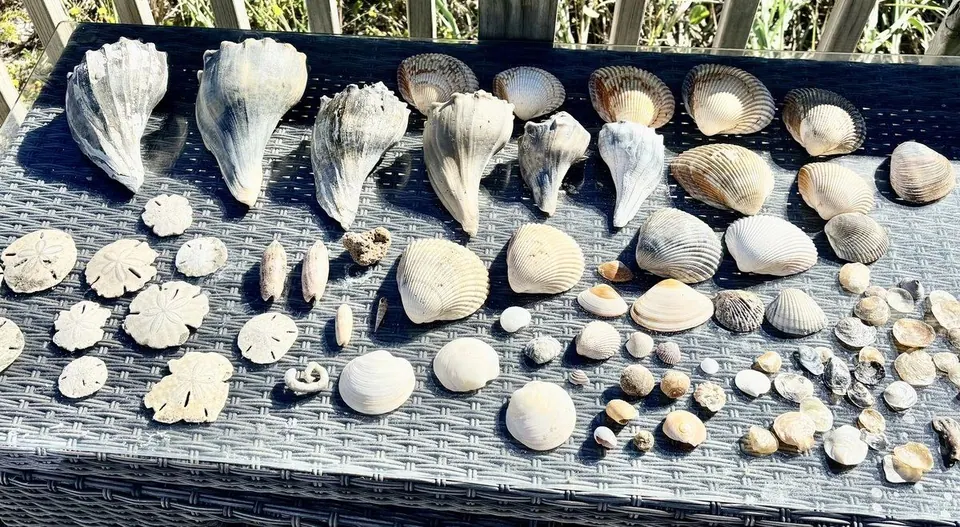
This guide covers 43 shells and beach finds you can actually turn up around Emerald Isle, from everyday treasures like whelks, cockles and lettered olives to rare prizes like the Scotch bonnet, North Carolina's state shell. You'll also find our tips for finding more shells on any trip, the local rules for what you can take home, and a featured section on fossil shark teeth.
Every shelling trip with Soundside Tours™ doubles as an Eco Tour: while you search the sand, you'll pass salt marsh, oyster rocks and barrier islands where ospreys, egrets, herons and pelicans feed. Ready to go?
When and Where to Find Shells
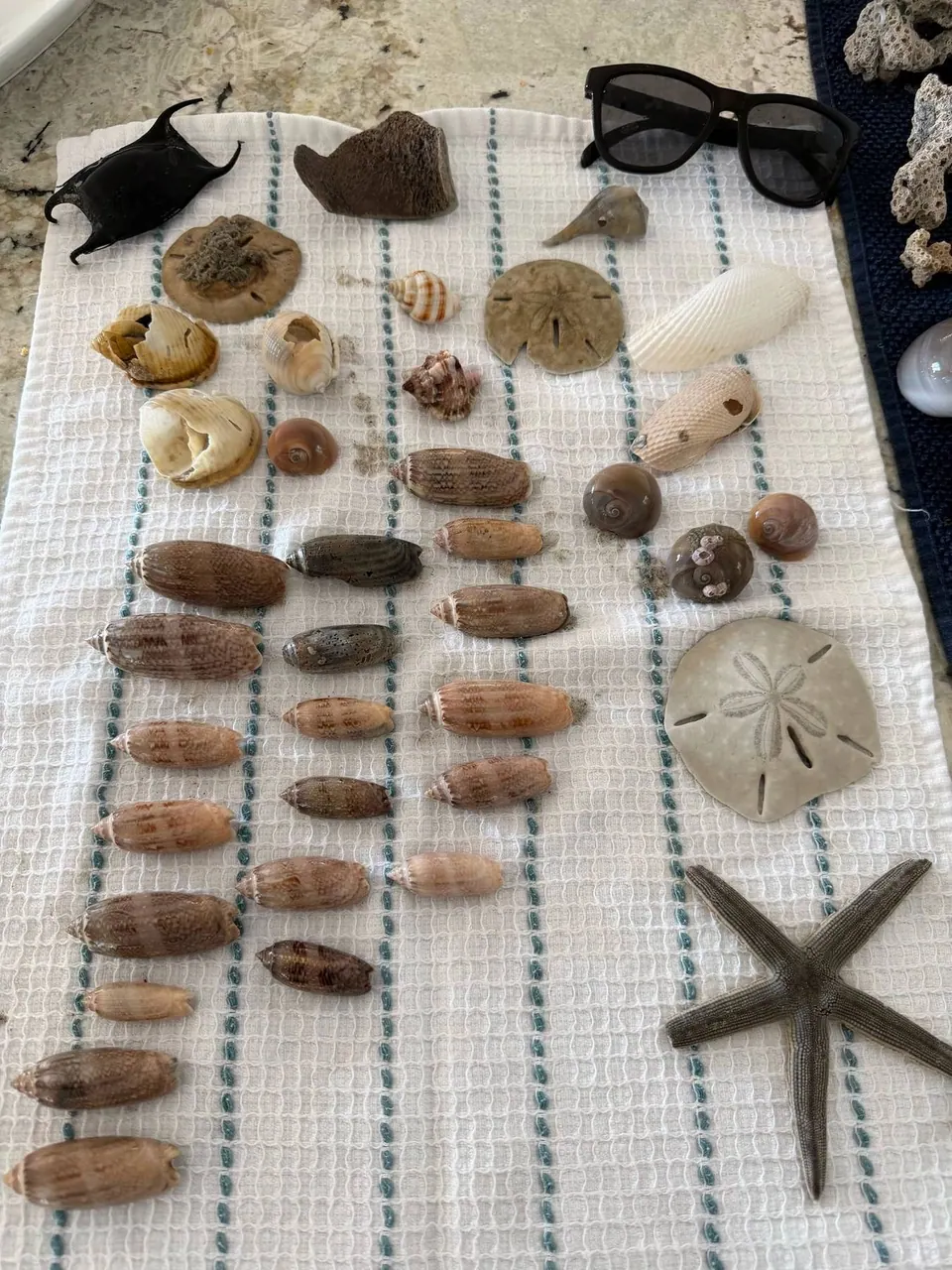
Shells turn up at every shelling stop.
Shells collect along the water's edge, in shallow troughs and on the beaches of the sound islands and sandbars, and we take you to the spots that look best that day.
Go after a blow.
Storms and strong northeast winds, especially in fall and winter, churn up the bottom and push fresh shells onto the beach. The day or two after is prime time.
Go early.
Morning shellers get first pick of whatever washed up overnight.
Read the shell lines.
Look where shells naturally pile up: the wrack line of seaweed and shell hash along the upper beach, the gravel bands on the inlet side of The Point, and the downstream edges of sound sandbars where the current slows.
Try the sound islands.
The islands and sandbars of Bogue Sound and the ICW are often covered in scallops, arks, cockles and whelks, and many of them are only reachable by boat.
North Carolina's State Shell: the Scotch Bonnet
In 1965, at the suggestion of the North Carolina Shell Club, the state made the Scotch bonnet its official state shell. It's a creamy, rounded snail checkered with rows of tan squares, a nod to the Scottish settlers who came to the state. It lives offshore, so a whole one on the beach is a real find. Your best odds are the ocean side of Bogue Banks after a winter storm.
Whelks, Conchs & Big Snails
Scotch Bonnet (NC State Shell)
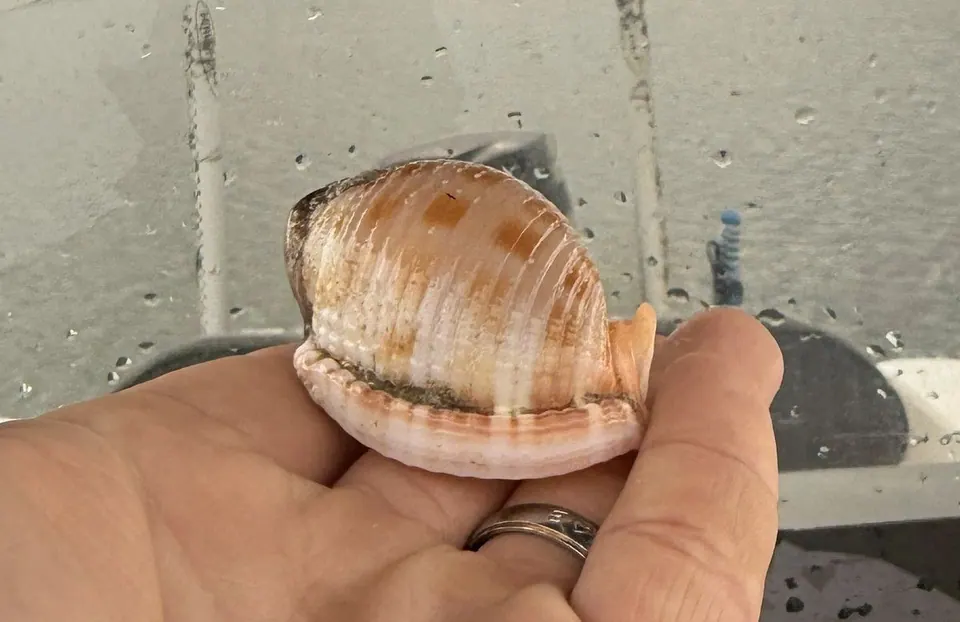
North Carolina's official state shell is a rounded, 2 to 4 inch snail with spiral grooves and rows of squarish tan or orange-brown spots on a creamy shell, a little like a plaid cap. The outer lip is thick and rolled. A whole, unbroken one is a real trophy, so keep looking along the wrack line after a blow.
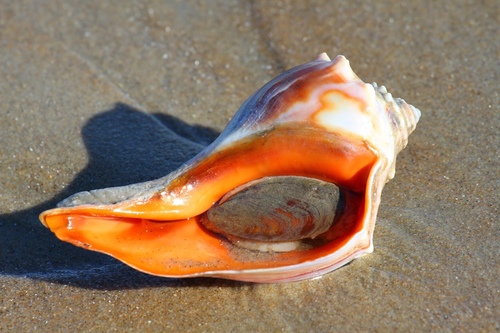
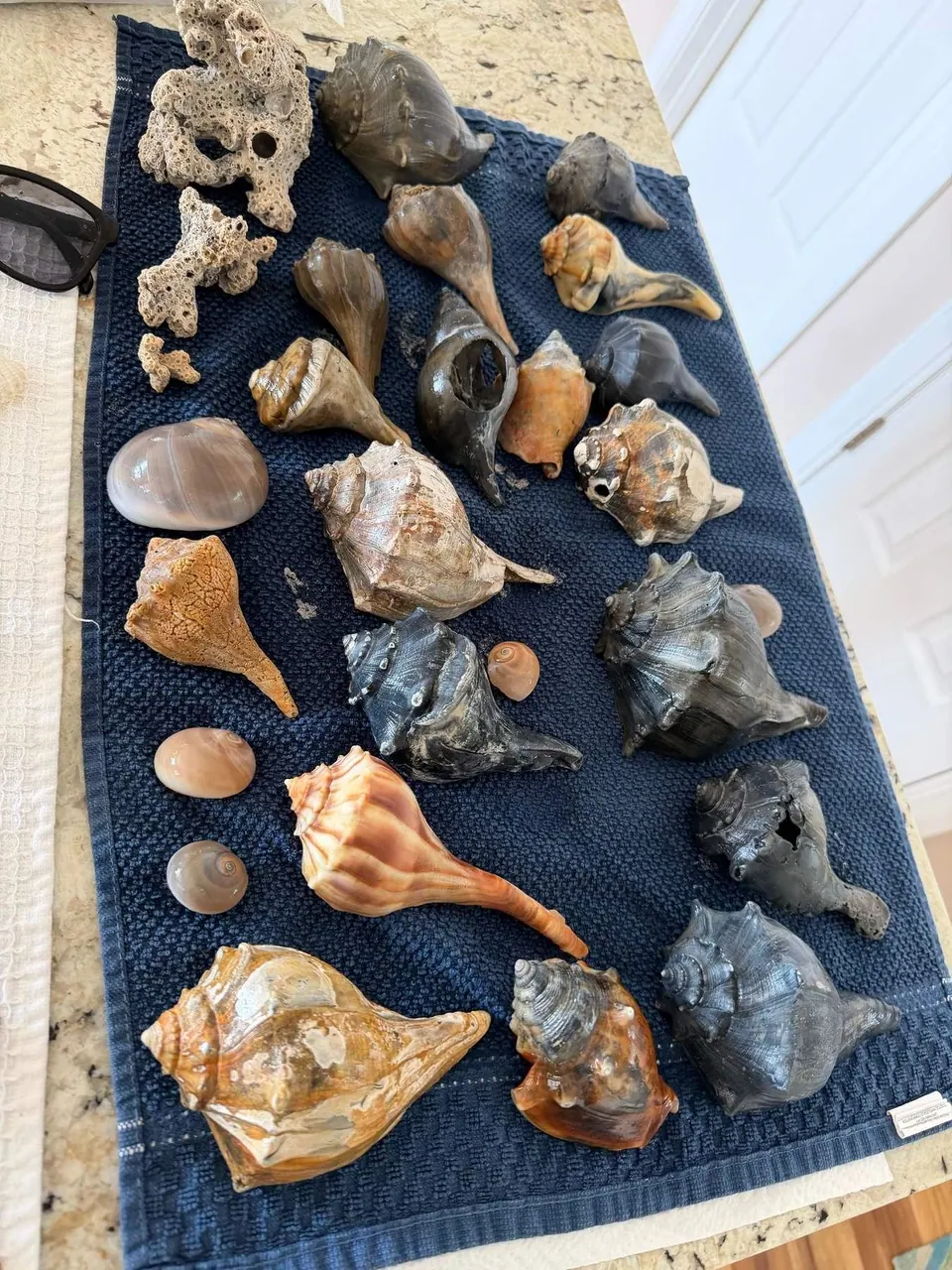
Knobbed Whelk
Our biggest everyday snail shell, up to about 9 inches, with a row of blunt knobs around the shoulder. Hold it point-up with the opening facing you: on a knobbed whelk the opening is on the right. Fresh shells are often orange or apricot inside.
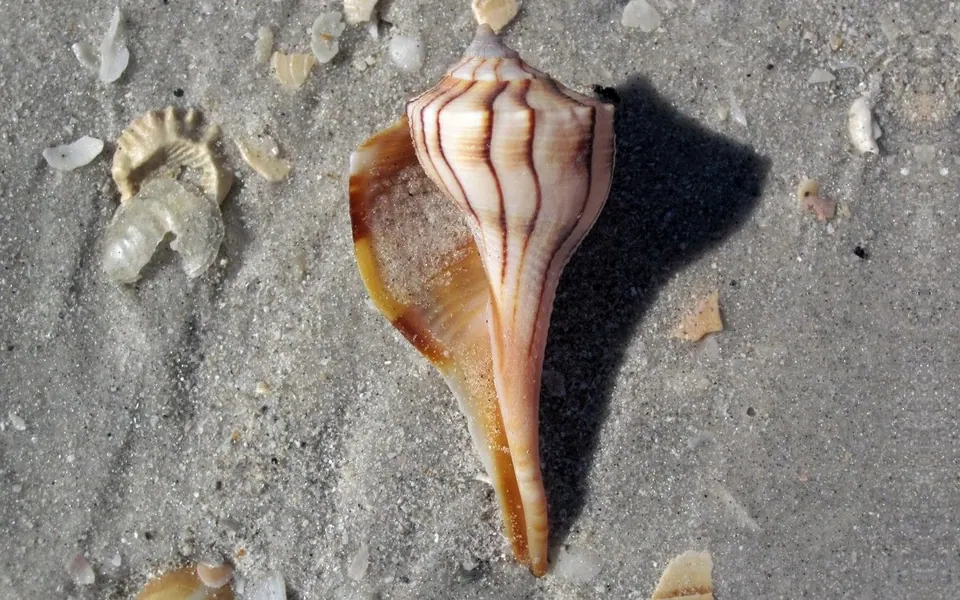
Lightning Whelk
The 'lefty' of the whelk family: hold it point-up and the opening is on the left. Younger shells carry wavy brown streaks that look like lightning bolts, and the shoulder knobs are smaller than a knobbed whelk's.

Channeled Whelk
A smooth, pear-shaped whelk up to about 7 inches with a deep groove (the 'channel') running along the spiral where each turn meets the next. Fresh shells may still wear a fuzzy brown skin. The opening is on the right, like the knobbed whelk.
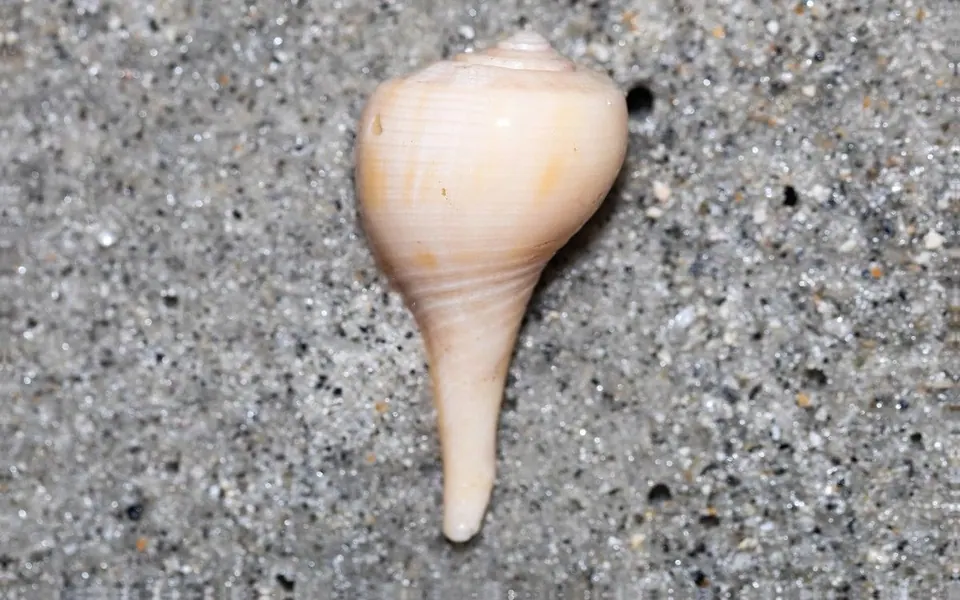
Pear Whelk
A smaller, fig-shaped whelk, usually 3 to 5 inches, with a smooth surface, a low spire and fine brown lines. It has no shoulder knobs, and the groove along its seams is much shallower than a channeled whelk's.
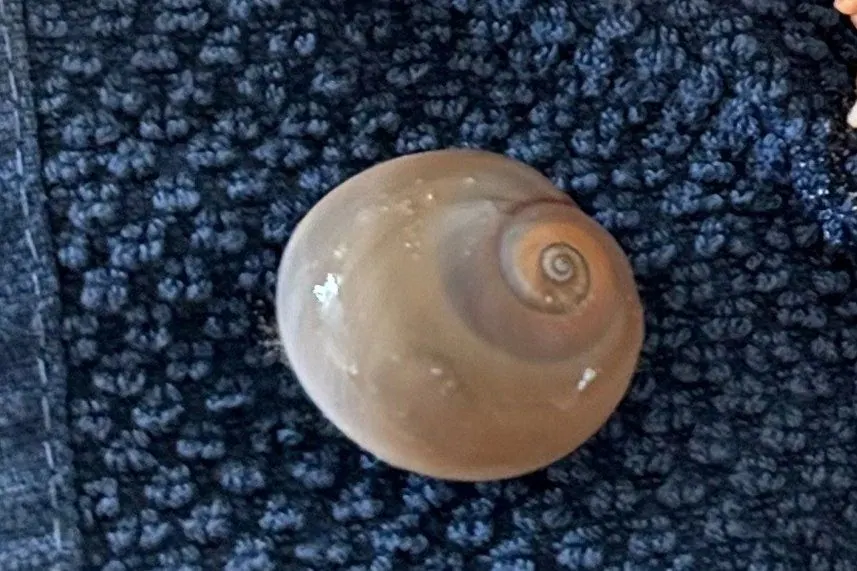
Shark Eye (Atlantic Moon Snail)
A round, glossy snail 1 to 3 inches across, gray-tan to bluish, whose spiral seen from the top looks like a staring eye. A brown pad covers the navel near the opening. Moon snails hunt clams by drilling a neat, beveled hole, which is why you find so many clam shells with a perfect round hole near the hinge.
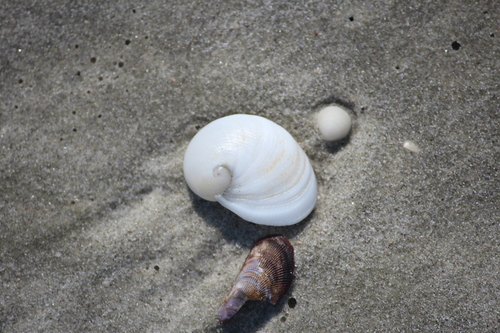
Atlantic Baby's Ear
A flat, white, ear-shaped shell about 1.5 to 2 inches long with very fine spiral lines and a huge opening. In life the animal's body almost completely covers it, so a clean empty one is a nice find.
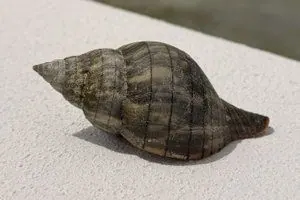
Banded Tulip
A smooth, spindle-shaped shell 2 to 4 inches long, cream to tan with soft mottling and thin dark spiral lines that run unbroken around the shell. It is a lovely, polished-looking find.
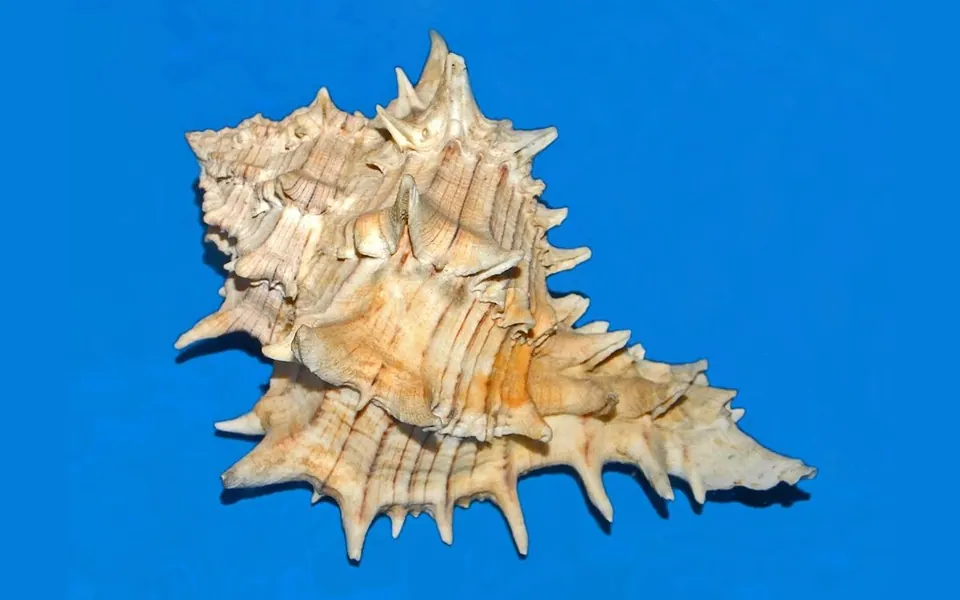
Giant Eastern Murex
A heavy, spiny shell, often 4 to 7 inches, with rows of frilly spines and fine brown spiral lines on a white to tan background. It lives offshore and around hard bottom, so a whole one on the beach is rare.
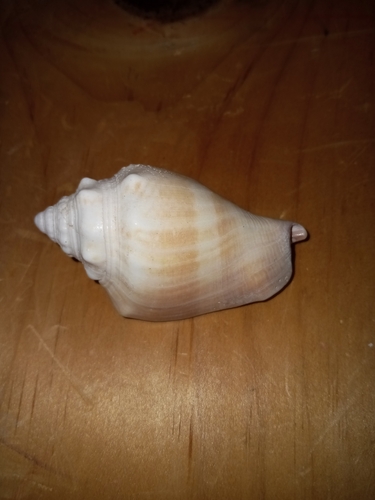
Florida Fighting Conch
A heavy, knobby 3 to 4 inch shell, orange-brown to purple-brown outside, with a flared lip and a glossy orange-pink interior. It is rare on Bogue Banks, so finding one is a lucky day.
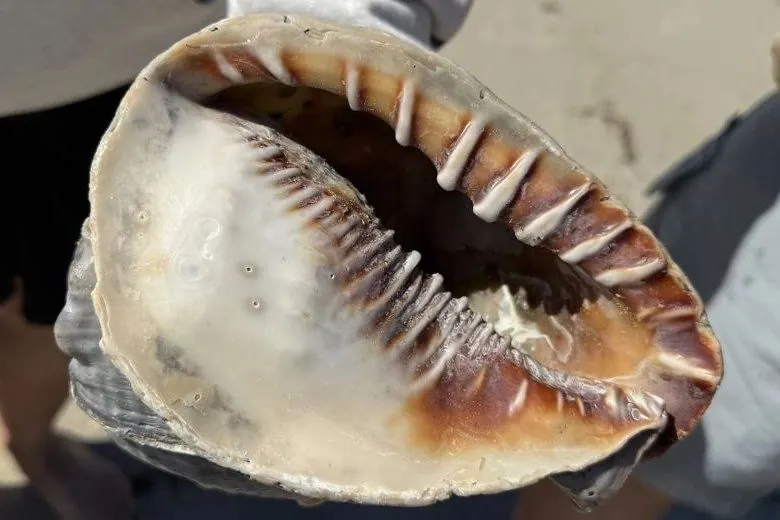
Queen Helmet
One of the biggest shells off our coast, growing up to about 14 inches. It is heavy and shield-shaped, and the underside has a wide, glossy cream shield with strong white teeth along both lips, set against dark brown. It lives offshore and feeds on sea urchins, so a whole one on the beach is a rare find, usually after a storm.
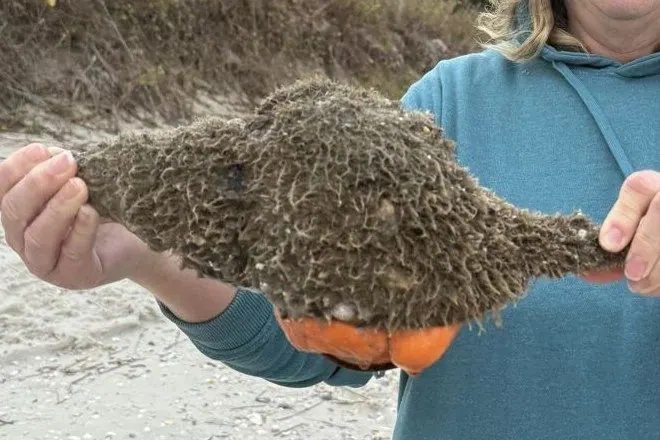
Horse Conch
The largest snail in U.S. waters, reaching up to about 24 inches, with a long spindle shape and knobs on the shoulder. Young shells are bright orange; older ones wear a flaky brown skin and are often crusted with growth. North Carolina is the northern edge of its range, so it is rare here. The animal inside is bright orange-red; if one is home, put it back in the water.
Olives, Augers & Small Snails
Lettered Olive
A glossy, cylinder-shaped shell about 2 to 2.5 inches long, cream or gray with brown zigzag markings that look like faint handwriting, and a long narrow slit for an opening. Live olives burrow just under the wet sand and leave little trails in the wet sand, so if it is heavy and has an animal inside, set it back down. Fun fact: it is South Carolina's state shell.
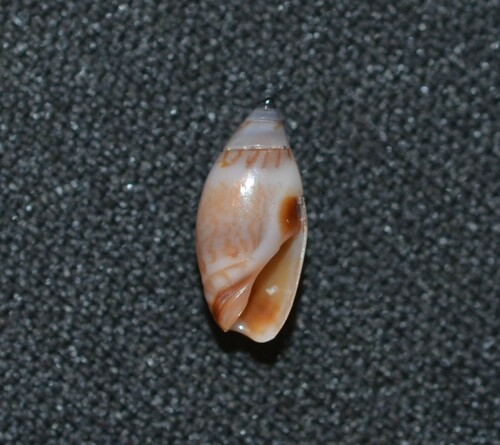
Variable Dwarf Olive
A tiny, shiny olive about half an inch long that comes in gray, tan, white or banded patterns. Look for them in the shell hash where the waves drop small shells; they are favorites for crafts and jewelry.
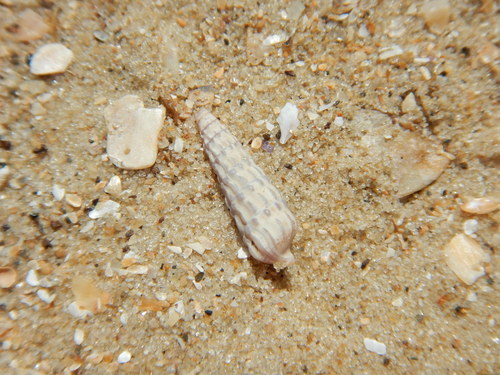
Atlantic Auger
A slim, tall spire 1.5 to 2.5 inches long with many tight turns, like a tiny drill bit. Look for a raised spiral band just below each seam and fine ribs; color ranges from gray to orange-tan.
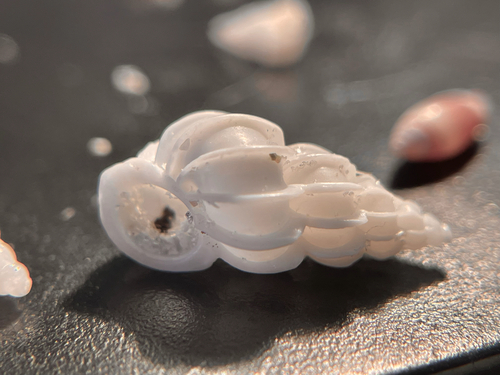
Angulate Wentletrap
A small, white, steeply spiraled shell under an inch long, wrapped in thin raised ribs that make it look like a spiral staircase, which is what 'wentletrap' means in Dutch. Easy to miss, beautiful up close.

Common Purple Sea Snail
A paper-thin, violet snail about an inch across. In life it drifts on the open ocean on a raft of bubbles, so it only washes in when steady winds push the open-water community ashore. Handle gently; it breaks easily.
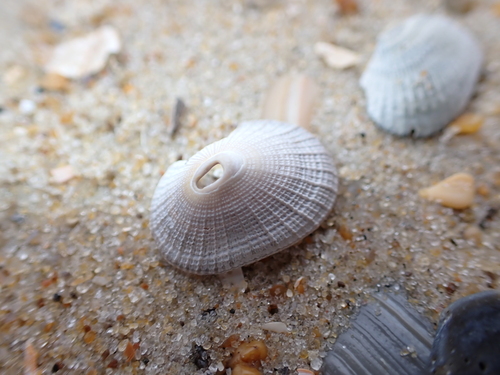
Cayenne Keyhole Limpet
A low, ribbed cone about an inch long with a small 'keyhole' opening at the top. It is grayish-white outside and smooth inside.
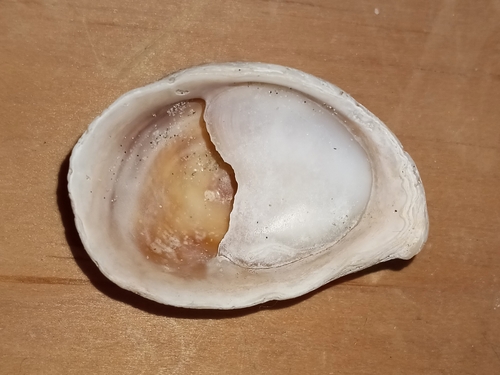
Common Atlantic Slipper Shell
A curved, oval shell 1 to 2 inches long with a white shelf inside that makes it look like a little slipper or boat. In life they stack on top of one another and ride on whelk shells and crabs.
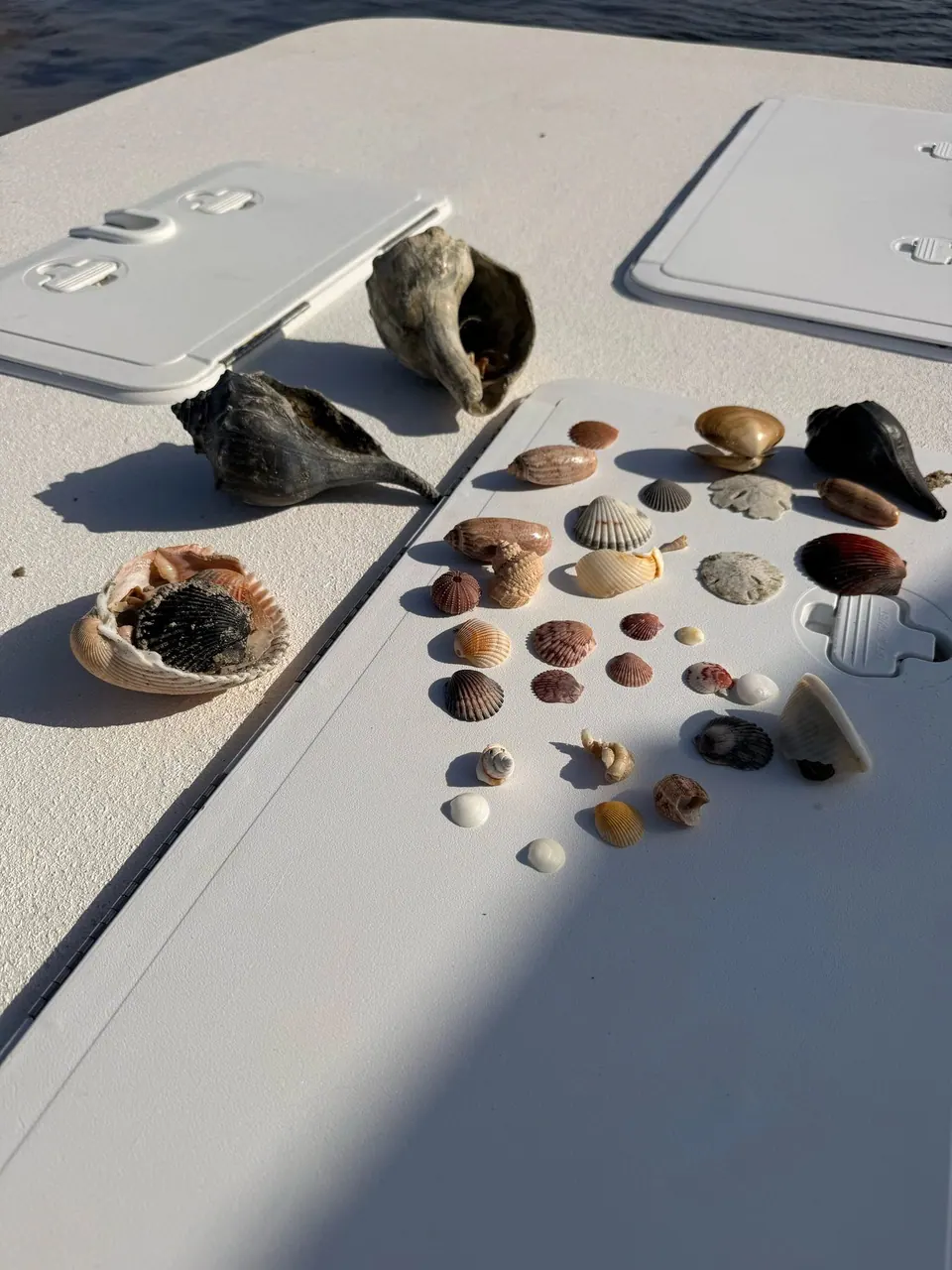
Sound & Marsh Shells
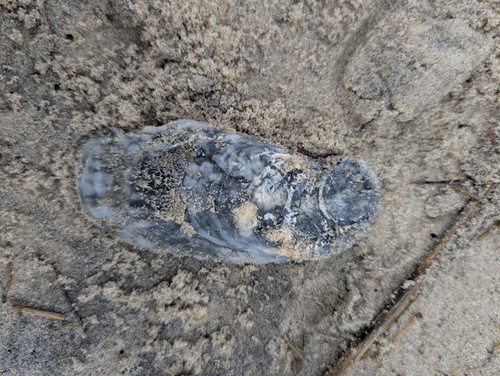
Eastern Oyster
Rough, gray, irregular shells 2 to 5 inches long that grow cemented together into oyster rocks along the sound. Oysters filter water and their reefs shelter fish and crabs. Their edges are razor sharp, which is one reason we ask guests to wear water shoes.
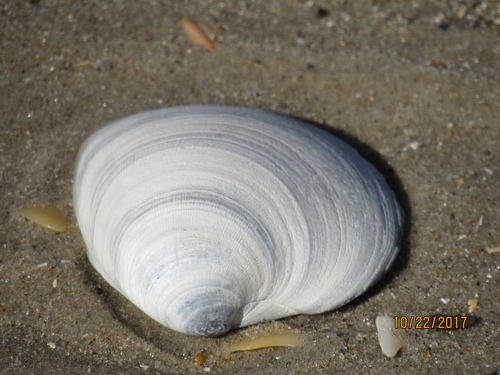
Hard Clam (Quahog)
A thick, heavy, rounded clam 3 to 4 inches long with fine concentric ridges outside and often a purple stain along the inside edge. That purple was once carved into wampum beads. Look for the moon snail's drill hole near the hinge.

Atlantic Bay Scallop
A classic fan-shaped scallop 2 to 3 inches across with about 17 to 20 ribs and two little 'ears' at the hinge, in gray, brown, mottled or occasionally orange. In life they live in seagrass beds and have rows of tiny blue eyes along their edges.
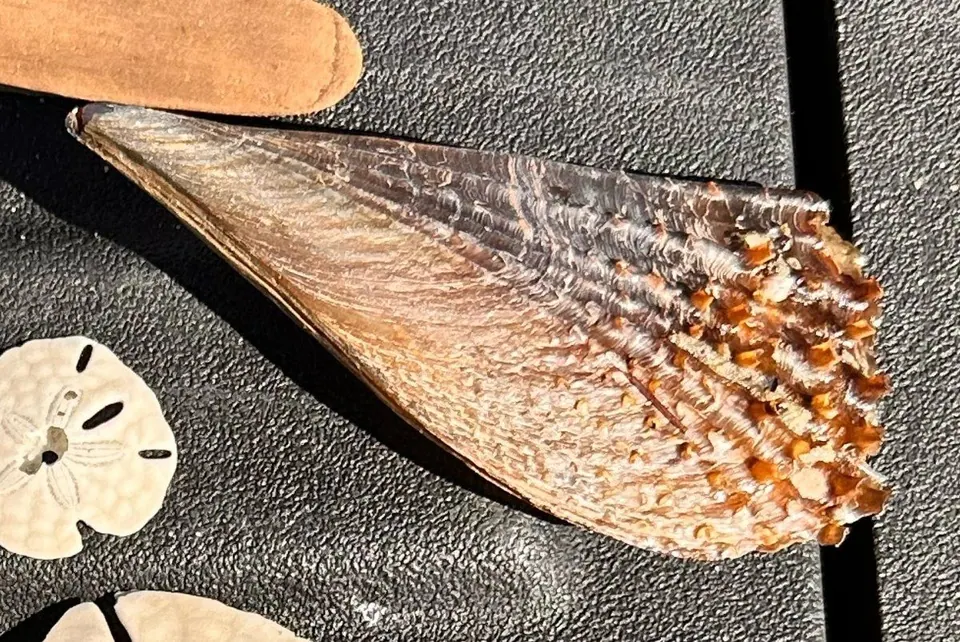
Pen Shell
A large, thin, fan-shaped shell up to about 9 or 10 inches long, brown to bronze, sometimes with small spines (sawtooth pen) or rows of tubes (stiff pen). Pens live standing point-down in the sand and break easily once they wash up.

Atlantic Jackknife Clam
A long, narrow, slightly curved shell 4 to 6 inches long that looks like an old-fashioned straight razor, with a shiny olive-brown skin. Live ones can dig straight down into wet sand surprisingly fast.

Atlantic Oyster Drill
A small, gray, ribbed snail about an inch long that preys on oysters by drilling through their shells. You will often spot them on and around oyster rocks.
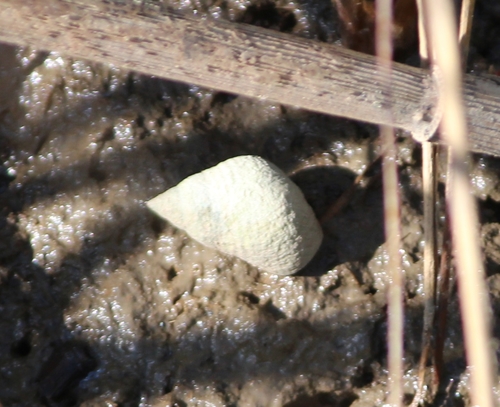
Marsh Periwinkle
A grayish-white, cone-shaped snail about an inch long with rows of tiny dark dashes. They climb the marsh grass stems to stay out of reach of hungry blue crabs, so look for them clinging to the grass on our Eco Tours.
Clams, Cockles, Arks & Scallops
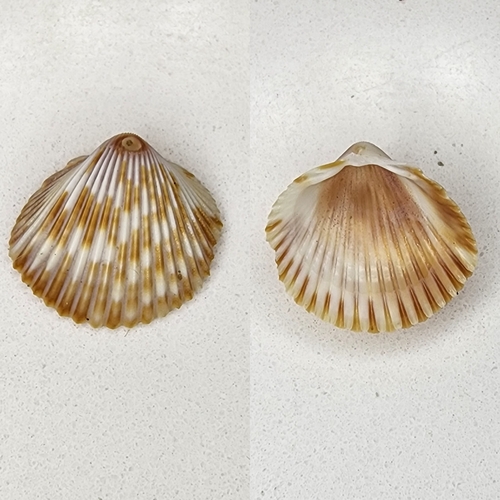
Atlantic Giant Cockle
A big, heart-shaped clam up to about 5 inches with roughly 30 to 36 strong ribs. Outside it is tan to reddish-brown; inside it is a smooth rosy pink to peach, which makes the halves popular for display.
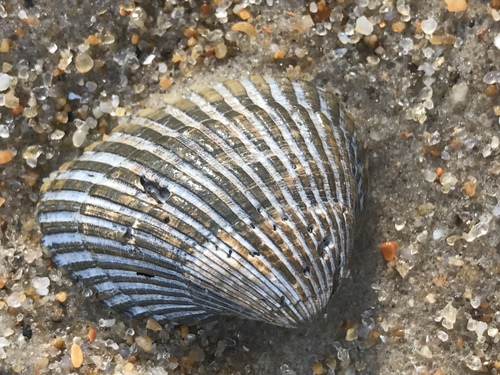
Ponderous Ark
A thick, boxy clam about 2 to 2.5 inches long with flat, grooved ribs and a long straight hinge lined with tiny teeth. Fresh shells wear a black, velvety skin; beach-worn ones are white.
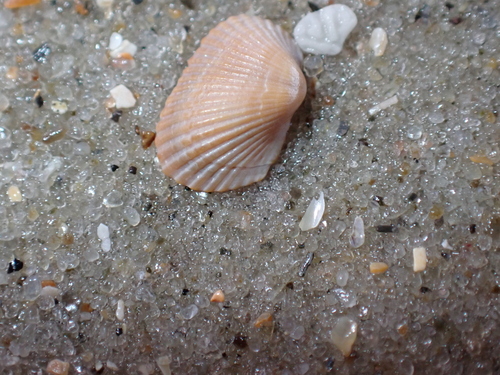
Transverse Ark
A small ark under an inch and a half long, longer than it is tall, with beaded ribs on one valve and a fuzzy brown skin when fresh. Look in the shell hash.
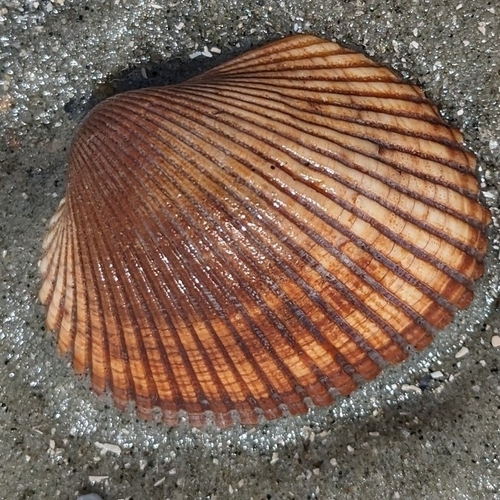
Blood Ark
An oval, strongly ribbed white ark 1.5 to 2.5 inches long. It gets its name from the animal inside, which has red blood, unusual for a clam.
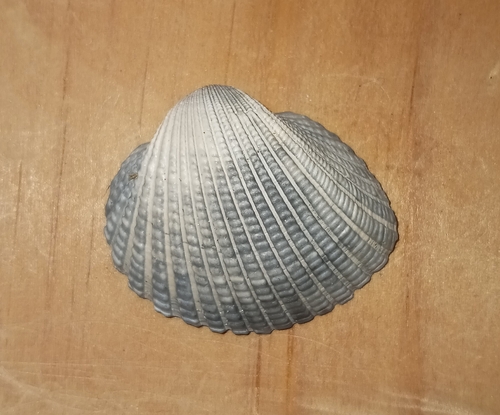
Incongruous Ark
A rounded white ark about 2 to 2.5 inches long with beaded ribs. Its two valves are not the same size, so one overlaps the other, which is where the 'incongruous' name comes from.
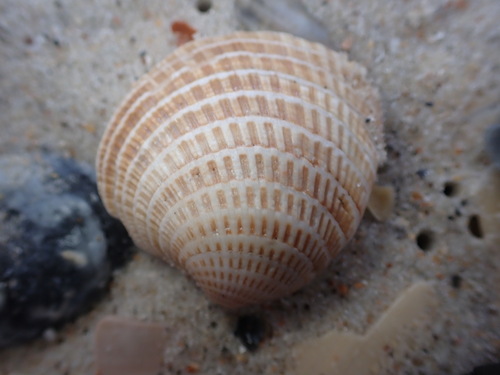
Cross-barred Venus
A thick little clam 1 to 1.5 inches long with a crisscross pattern of raised ridges and often brown or purple markings. Inside, many are tinted purple.
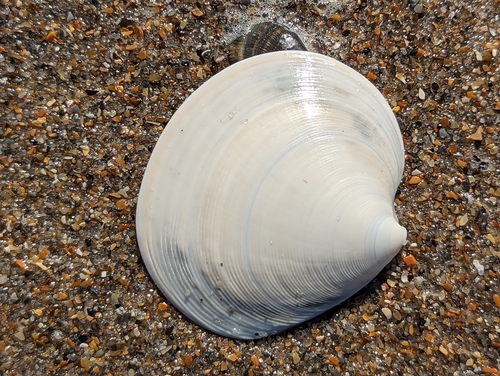
Disk Dosinia
A nearly circular, flat clam 2 to 3 inches across, glossy cream to pale yellow with very fine, even ridges, like a polished coin.
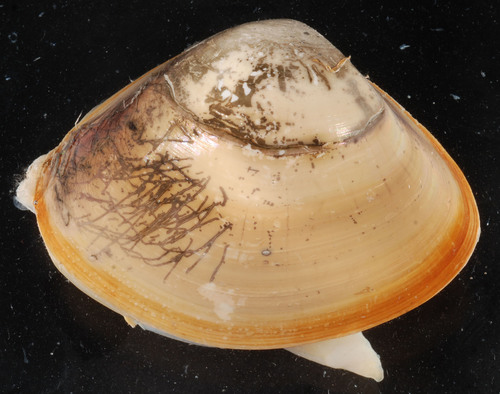
Atlantic Surf Clam
A big, smooth, triangular clam 4 to 7 inches long, tan to cream, with a spoon-shaped pit at the hinge. Kids love using the halves as sand scoops.
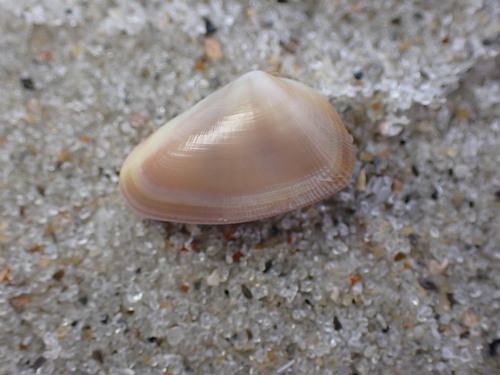
Coquina Clam
A tiny wedge-shaped clam under an inch long that comes in sunrise colors: pink, purple, yellow, orange and white, often still joined like butterfly wings. Live coquinas dig back in after every wave and are a favorite food of shorebirds.
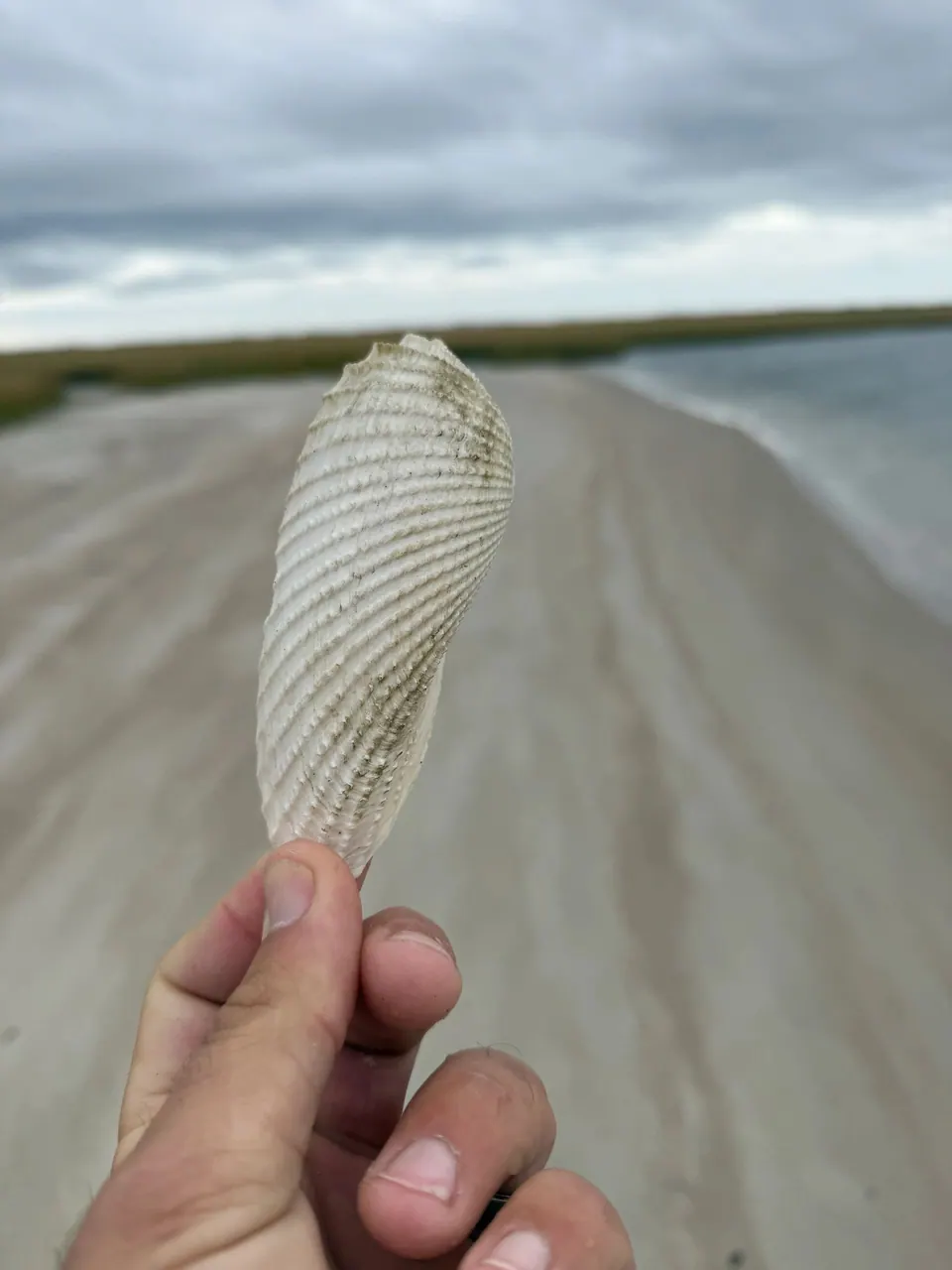
Angel Wing
A thin, pure-white, wing-shaped shell 4 to 8 inches long with rows of scaly ribs. The animal burrows deep into mud, and the shells are fragile, so finding a whole matched pair is special.
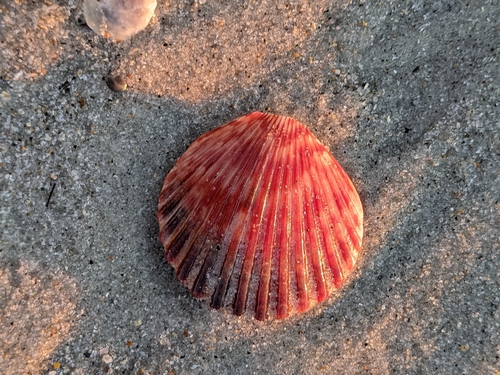
Calico Scallop
A small scallop 1 to 2.5 inches across with about 20 ribs and bright, mottled color in pink, red, purple, yellow or white, like calico fabric. It lives offshore and washes in.
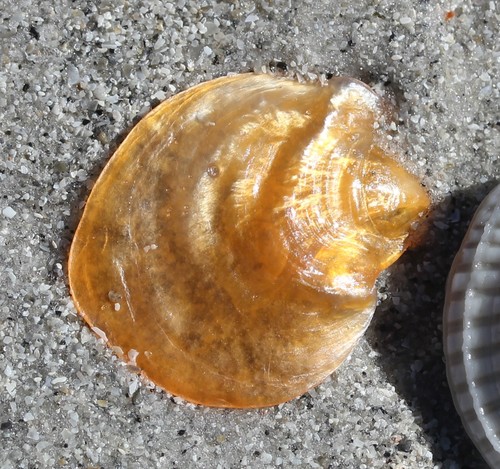
Atlantic Jingle Shell
Thin, shiny, almost translucent shells 1 to 2 inches across in gold, orange, silver or black. Black ones were stained by being buried in sediment. Strung together, they really do jingle.
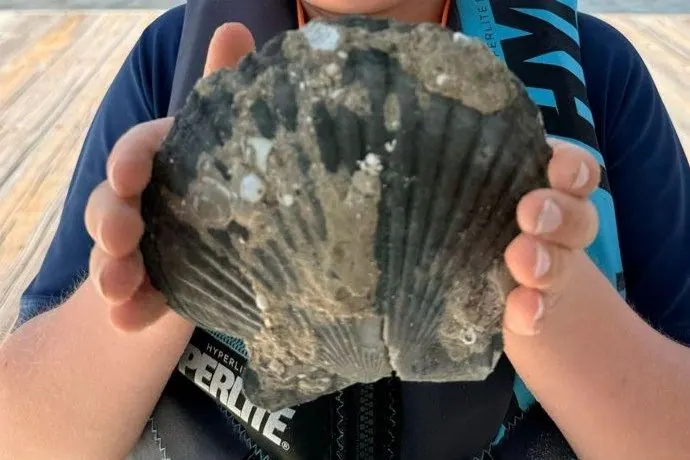
Fossil Scallop
Big, thick scallop shells stained black, gray or brown are fossils, often millions of years old. Like fossil shark teeth, they wash out of old sediment layers and were darkened by minerals while buried. They are much heavier than a modern bay or calico scallop, with strong ribs, and are often crusted with barnacles or other growth.
Where to Find Sand Dollars Near Emerald Isle
Sand dollars are one of the finds guests ask about most, so here is the short answer before you meet them up close below. Look on quiet sandbars and island beaches in Bogue Sound, and at The Point on the west end of Emerald Isle, mostly around low tide and in the day or two after a storm. Our Shelling Adventure and Serious Shellers Cruise stop at Bogue Sound islands where sand dollars often wash up. Finds are never guaranteed.
Only take the white, sun-bleached ones. A live sand dollar is brown or purple and fuzzy with tiny moving spines, so gently put it back in the water.
Heard about Sand Dollar Island? That is a sandbar near Beaufort, about 40 minutes east of our boat ramp, reached by ferries from Beaufort and Morehead City. Our trips leave from Emerald Isle and visit different islands in Bogue Sound.
Sand Dollars, Sea Biscuits & Egg Cases
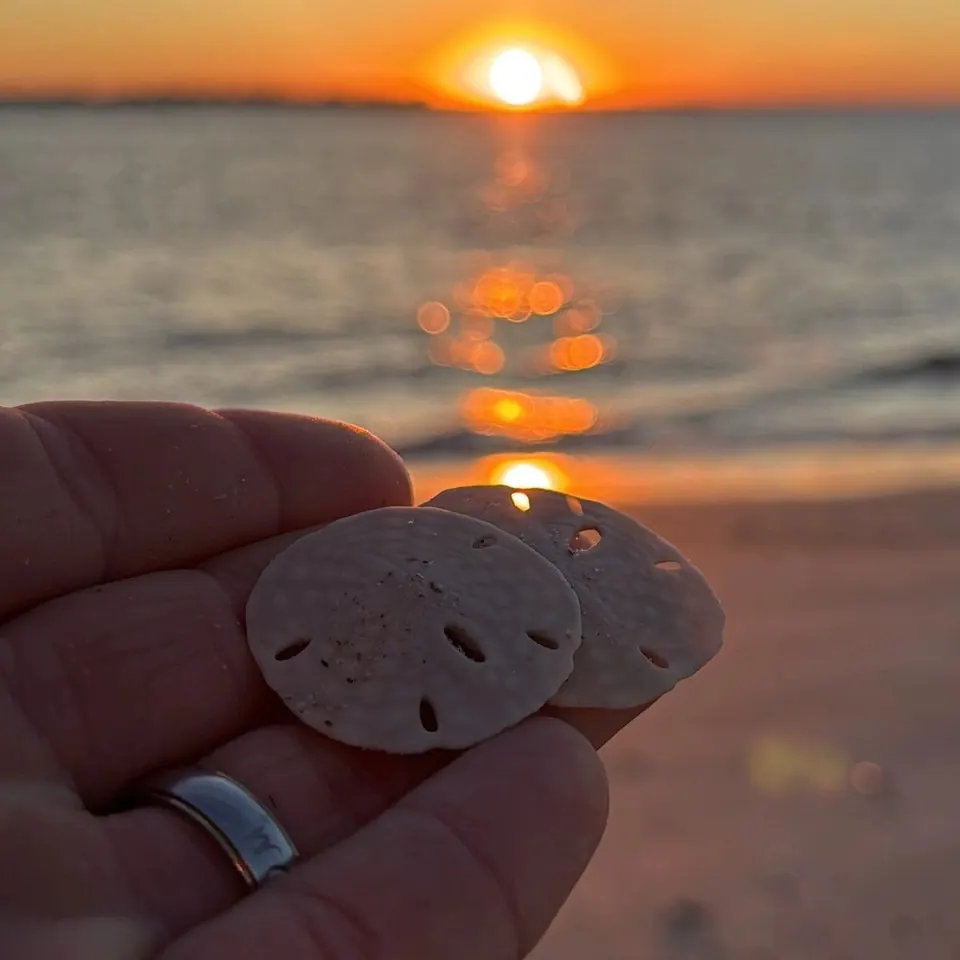
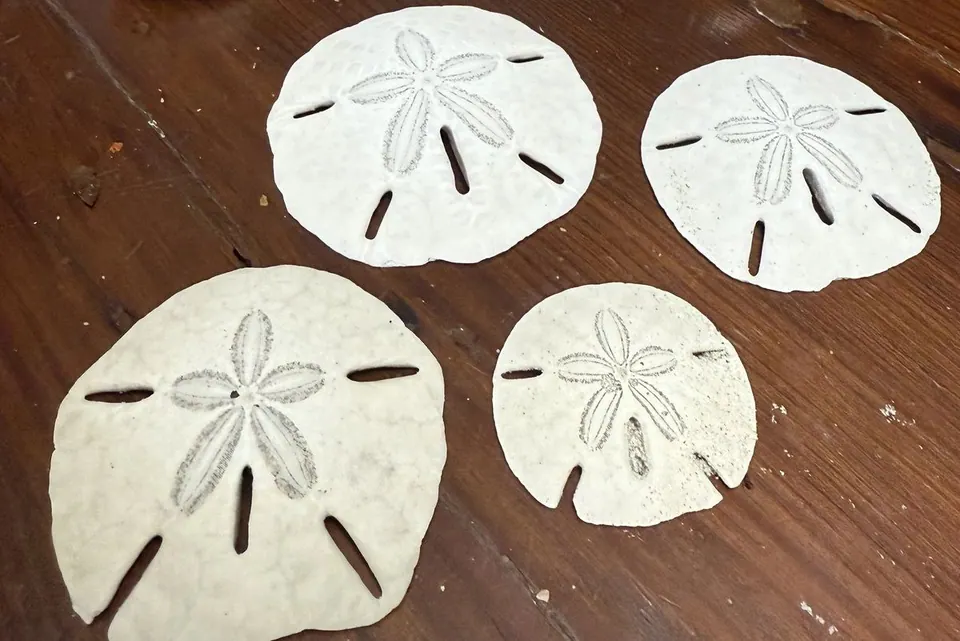
Five-slotted Sand Dollar
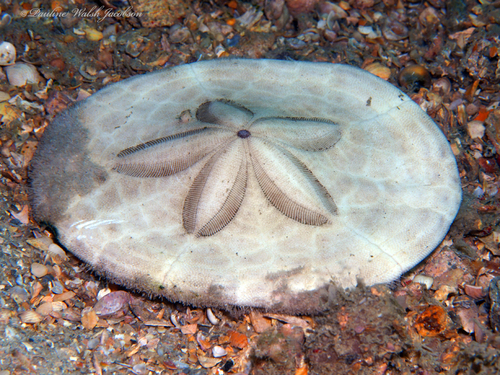
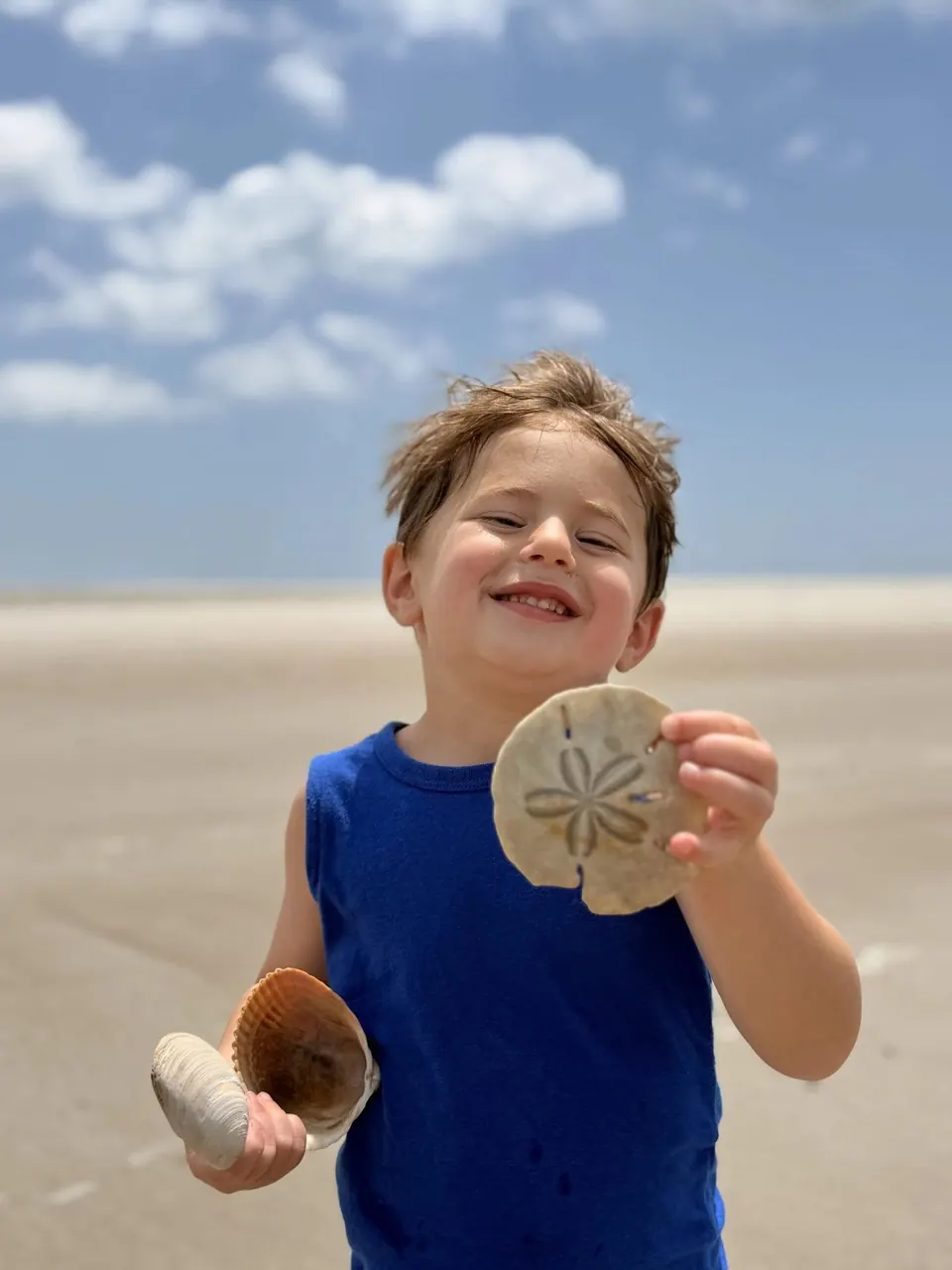
A flat disk about 2 to 4 inches across with five slots and a five-petal flower pattern on top. Live sand dollars are brown or purple and covered with tiny moving spines; only the sun-bleached white ones are ready to take home.
Sea Biscuit
A thicker, domed cousin of the sand dollar, 3 to 5 inches long, with the same petal pattern on top but no slots. It is rare on Bogue Banks. (Locally, people sometimes also call heart urchins 'sea biscuits.')
Skate Egg Case ('Mermaid's Purse')
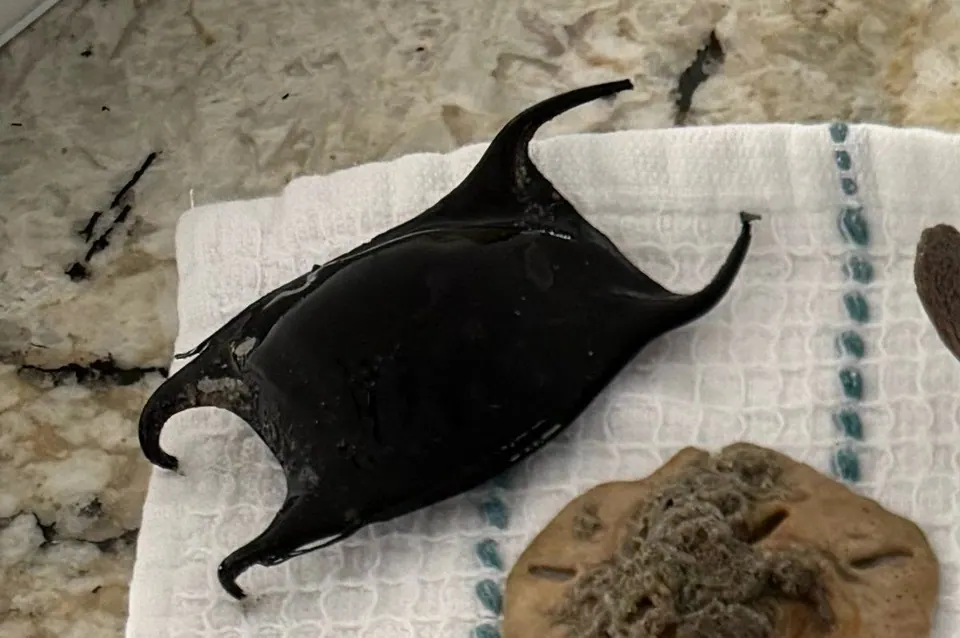
A dark, leathery, rectangular pouch 2 to 3 inches long with a curly horn at each corner. Each one held a baby skate; the ones that wash up dry and crispy are almost always empty.

Whelk Egg Case String
A papery string of coin-shaped capsules that can stretch a couple of feet. Each capsule held many tiny whelks, and you can sometimes hear the baby shells rattle inside. If the capsules are still moist and full, leave the string in the water.
Fossil Shark Teeth: Hunting the Crystal Coast's Oldest Treasure
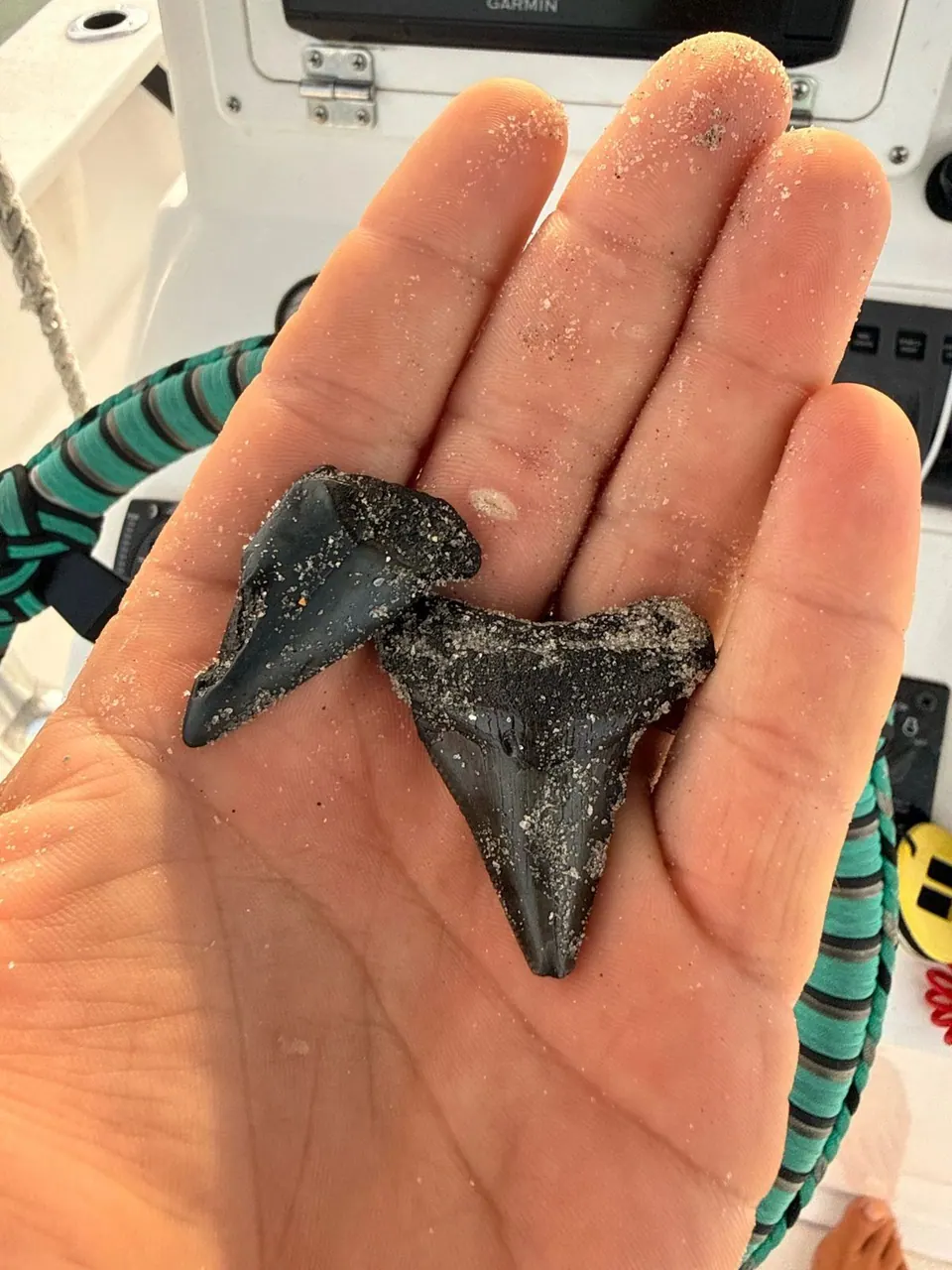
Shark teeth are some of the most exciting finds around Emerald Isle. Sharks lose and replace teeth all their lives, and in the warm, shallow seas that covered eastern North Carolina millions of years ago, those teeth piled up in the sediment and slowly fossilized. Waves and currents now erode those old layers and wash the teeth onto our beaches and sound shorelines.
North Carolina even made the fossilized tooth of the giant megalodon shark its official state fossil in 2013. Most of the teeth you'll find are much smaller, usually a quarter inch to an inch long, but every one is millions of years old.
How to Tell a Fossil Shark Tooth
- Color: Fossil teeth are black, gray, brown or sometimes tan, never bright white. Minerals replaced the original tooth while it was buried.
- Shine: The blade (crown) has a smooth, glossy enamel that catches the light, even when it's wet and sandy. Shell fragments look dull, chalky or layered.
- Shape: Look for a triangle or dagger shape with a point, and a root at the base. The root is usually duller and shaped like a V or U.
- Feel: Run a fingernail over it. The enamel feels slick and hard, while shell pieces feel rough or flaky.
- Symmetry: Many shell bits are random shapes. A tooth is neatly symmetrical or gently curved.
Teeth You Might Find
- Sand tiger shark: Long, narrow and dagger-like, often with tiny side points (cusplets) at the base. One of the most common finds.
- Snaggletooth shark (Hemipristis): An extinct shark with curved upper teeth edged in big, jagged serrations, hard to mistake for anything else.
- Lemon and bull sharks (requiem sharks): Lemon shark teeth have a slim, smooth point on a wide base; bull shark teeth are broad, triangular and finely serrated.
- Tiger shark: Short, wide teeth with a notch on one side and serrations, shaped a little like a rooster's comb.
- Mako shark: Smooth, blade-like and slightly curved, with no serrations.
- Megalodon (rare): Big, thick, triangular teeth with fine serrations and a dark band (the bourlette) between blade and root. Whole ones are very rare on our beaches; fragments turn up occasionally.
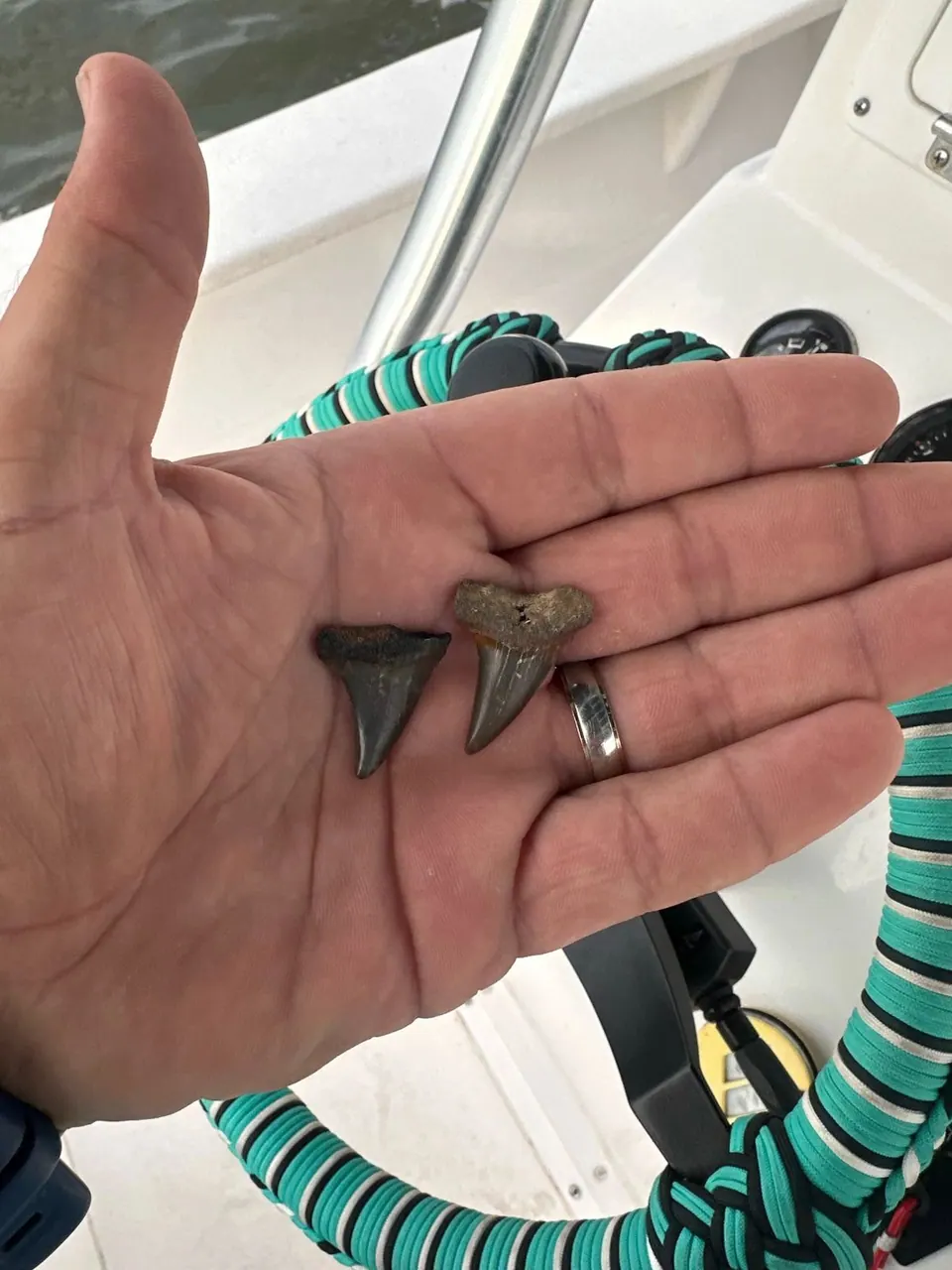
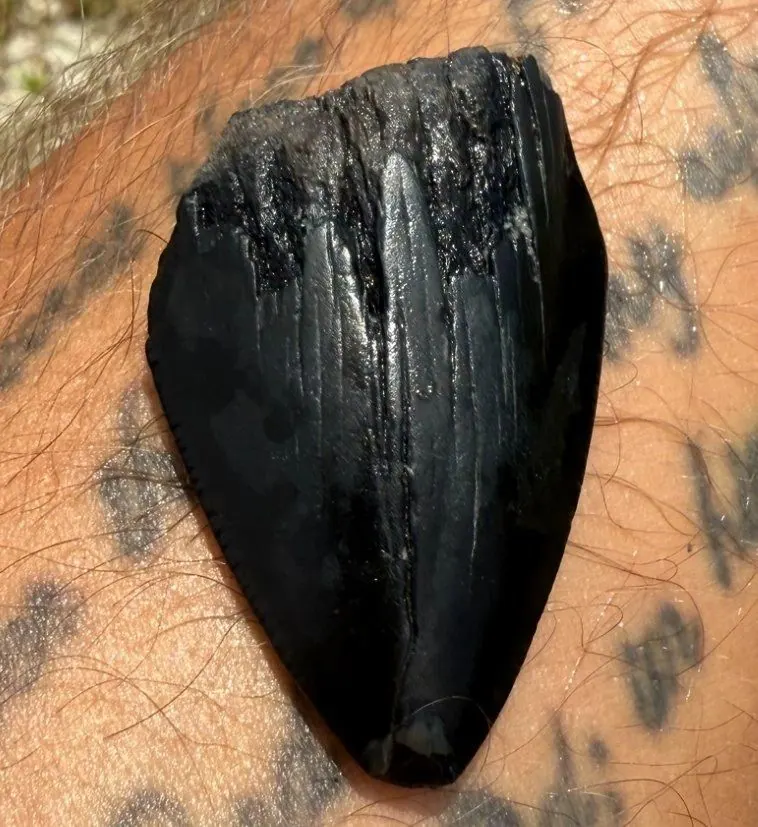
A megalodon tooth, North Carolina's state fossil.
Where and When to Look
Look in the bands of shell hash and gravel at the water's edge, especially after storms, on the inlet side of The Point and along sound shorelines. Get low, scan slowly for small dark triangles, and check the backwash as each wave pulls out. Finds depend on conditions and a bit of luck, so we never guarantee them.
Want to try it with a local captain? The 2-hour Shark Tooth Adventure Eco Tour takes your private group by boat to shoreline spots where teeth wash up.
Book Now: Shark Tooth AdventureShelling Rules and Beach Etiquette
We want these beaches and islands to stay full of shells and birds for the next family, so we follow a few simple rules on every trip, and we ask our guests to do the same.
- Take only empty shells. If a shell is heavy, has a door (operculum) or an animal inside, or a sand dollar is brown or purple and fuzzy, it's alive. Set it gently back where you found it, in the water. The same goes for live sea stars, sea urchins and whelk egg strings that are still moist and full.
- Live shellfish are regulated. Harvesting live clams, oysters, scallops and whelks in North Carolina falls under NC Division of Marine Fisheries rules on seasons, limits and closed areas. On our trips we keep it simple: no live animals go home.
- Take a handful, not a bucket. Leave plenty for the birds, the hermit crabs and the next sheller. Broken shells also become homes and habitat.
- On Bear Island (Hammocks Beach State Park), you may keep the empty shells you find. Please take only empty shells, and leave anything alive where you found it.
- Give nesting birds their space at The Point. We often land at The Point at the west end of Emerald Isle, right next to a protected bird nesting area. From about April through August, least terns and Wilson's plovers nest on the open sand there, and the area is marked with posts, string, flags and signs. Please stay outside the roped areas, keep kids and pets well back, and never chase or flush birds. If the terns start calling and diving at you, you're too close, so slowly back away. Their eggs and chicks look exactly like sand. The marked area changes each year, so always follow the signs that are posted that day.
- Watch for sea turtle nests. Sea turtles nest on our ocean beaches from about May through October. Stay away from any marked nest and fill in holes you dig before you leave.
- Leave no trace. Pack out everything you bring, pick up any plastic you see, and leave the sand smoother than you found it.
Why Go Shelling by Boat?
A boat gets you to the remote islands and untouched shorelines of Bogue Sound and the ICW, and lets you hop between several spots in one trip, and your captain knows the local waters, with more than 10 years on the Crystal Coast.
What to Wear and Bring
Non-marking waterproof shoes (you'll walk on sand, uneven ground and along the water's edge). Sun protection: hat, sunscreen and sunglasses. Clothes that can get wet. A bag or container for your finds. A cooler with water is provided on the boat. Your own snacks and drinks are welcome. Cheers to the view, not the buzz: grown-ups can bring something to sip, but we keep it easygoing and family-friendly, so pace yourself.
Shelling Tours from Emerald Isle
Shelling Adventure – 3 hours
Island hopping on the ICW with stops at shelling spots along the way, a good fit for families and first-timers.
Serious Shellers Cruise – 5 hours
More time on remote islands and untouched shorelines for dedicated shell hunters; expect a lot of walking.
Add "Need Help Shelling?" for $100 when you book. Want a shorter trip focused on shark teeth? Try the 2-hour Shark Tooth Adventure.